
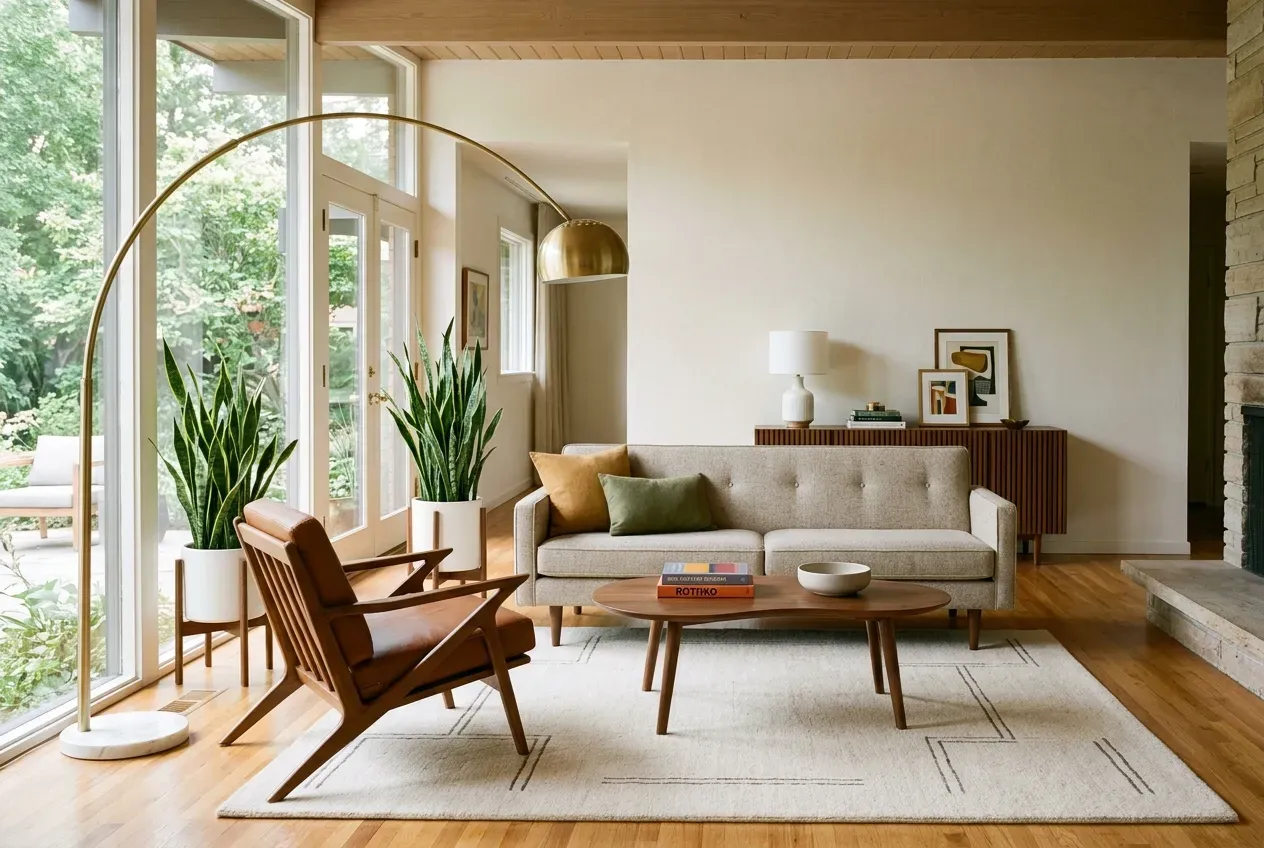
Start a mid-century modern living room by keeping sightlines low and the floor visible. A tailored sofa with tapered wooden legs, a slim walnut coffee table, and an open armchair set the foundation faster than an armful of retro accessories. When furniture sits elevated on slender legs, daylight moves underneath, making the room feel open and easy to navigate.
The goal is not to stage a period film set or fill an antique showroom. A timeless mid-century space balances vintage design principles—clean lines, organic curves, and warm wood—with modern everyday comfort like supportive deep seating, durable fabrics, and hidden electronics.
Anchor the seating with clean lines and tapered legs
Mid-century seating relies on defined geometry and light visual weight. Instead of buying a matching three-piece suite, pair complementary silhouettes in contrasting materials so the room feels assembled over time.
Choose a sofa with architectural simplicity
Look for a sofa with a continuous back, shallow button tufting or crisp welt cord seams, and narrow track arms. Bulky overstuffed couches swallow mid-century proportions. A seat height between 17 and 18 inches keeps lounging comfortable while maintaining a low horizon across the room.
Exposed wooden legs—either straight pegs or slightly splayed dowels—give the sofa its floating stance. For daily comfort, choose a design with a single long bench cushion and high-resilience foam wrapped in down. It provides solid support for reading or streaming movies without constant cushion shifting.
Pair with sculptural accent chairs
Complement the sofa with one or two chairs featuring exposed wood frames. Danish lounge chairs with paddle arms, reclined timber backs, and woven webbing introduce visible craftsmanship from every angle.
Placing a curved leather bucket chair or a molded plywood shell chair opposite a linear fabric sofa breaks up straight angles. Keep the chair legs visually lighter than the sofa base to maintain a balanced layout.
Balance warm walnut with breathable textures
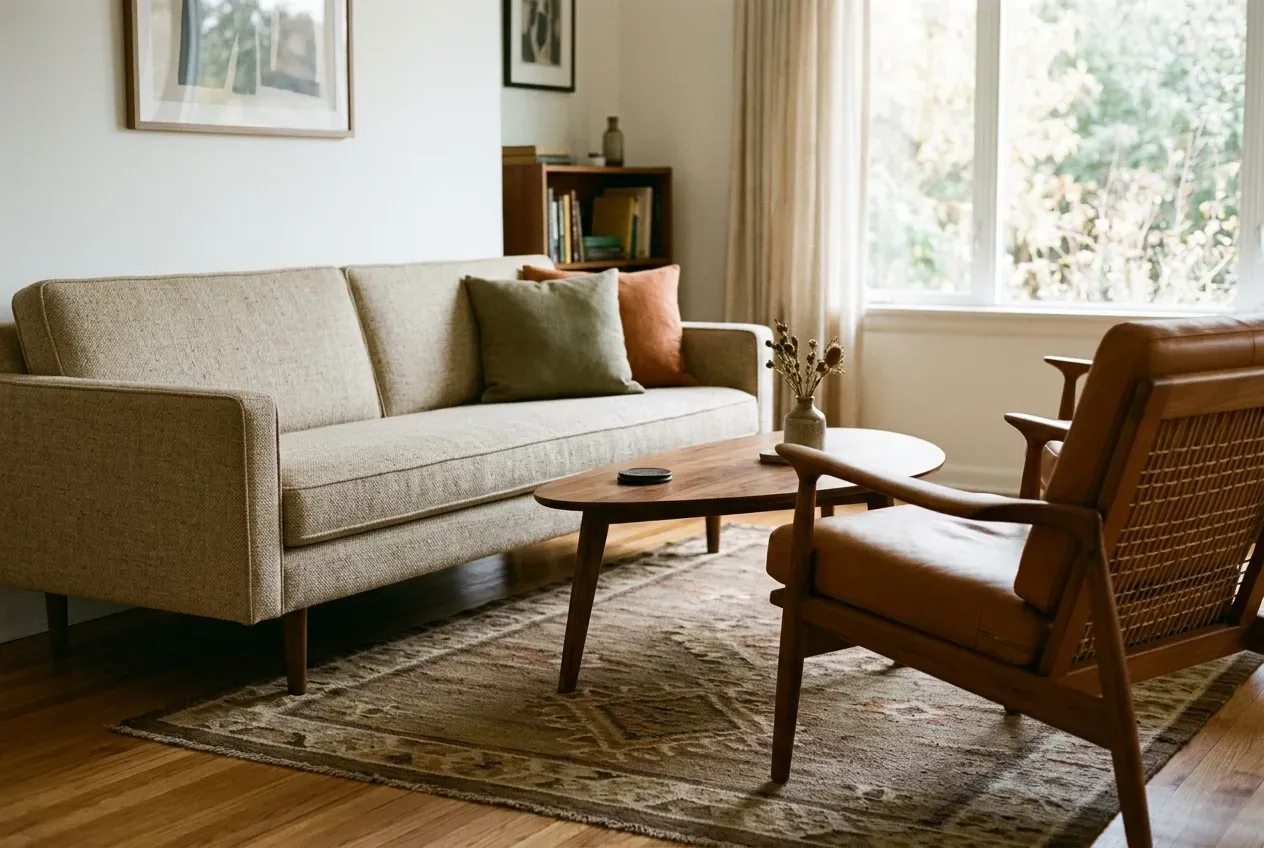
Wood gives mid-century spaces their welcoming warmth. American walnut and teak offer distinctive open grains that soften smooth drywall and neutral flooring.
Choose wood finishes that highlight natural grain
Anchor the conversation area with a walnut coffee table shaped with soft organic contours, such as an asymmetrical kidney, an oval surfboard, or a rounded rectangle. Rounded corners ease foot traffic in compact seating layouts while showcasing the tabletop grain.
Limit matched wood sets to keep the space relaxed. A walnut sideboard pairs naturally with an oak side table or a travertine-topped cocktail table, provided the wood tones share a warm amber undertone. Skip high-gloss lacquers; low-sheen satin and natural oil finishes reflect the honest matte look of original mid-century carpentry.
Layer tactile upholstery and restrained color accents
Balance dark timber with tactile fabrics that catch natural light:
- Neutral foundations: Oatmeal, heather gray, warm cream, and biscuit upholstery let furniture silhouettes stand out clearly.
- Earthy accent tones: Introduce classic mid-century hues through throw pillows and drapery using moss green, burnt ochre, rust orange, and deep petrol blue.
- Textural contrast: Pair a flat-woven tweed sofa with a saddle-leather armchair and a linen pillow to keep a quiet palette interesting.
Limiting the palette to two wood finishes and three textile accent shades keeps the interior calm and cohesive.
Hide modern media in a low-profile credenza
Flat-screen televisions and audio gear can break a mid-century look if mounted too high or left with tangles of wires. Low-slung storage solves this cleanly.
Anchor the television with a long sideboard
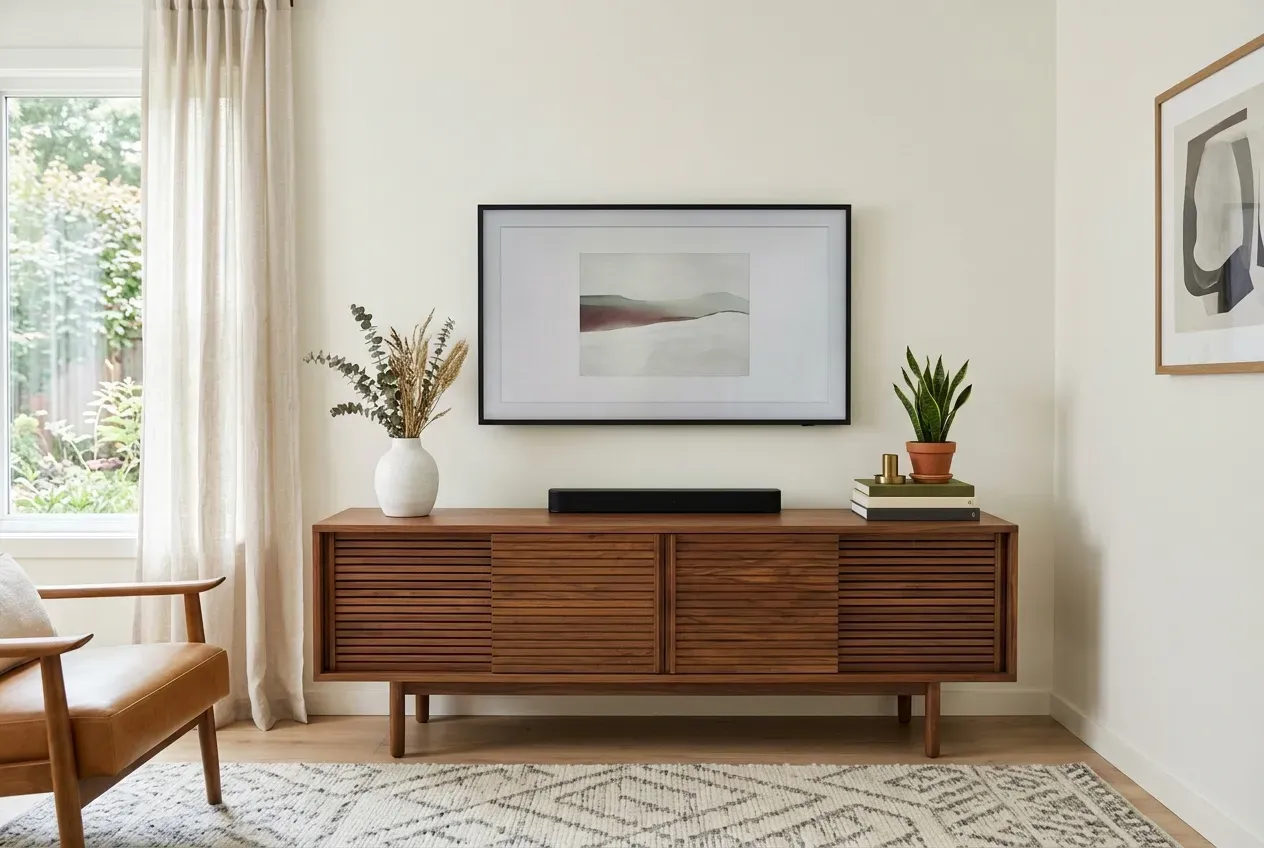
Pick a low walnut credenza measuring between 22 and 28 inches in height. Mid-century media units sit noticeably lower than standard consoles, keeping the screen at natural seated eye level. Choose a cabinet wider than the television by at least 8 to 12 inches on each side so the screen looks properly grounded.
Sliding slatted doors, tambour fronts, or cane inserts are practical choices. They let remote signals pass through to media streaming boxes while keeping game consoles, power strips, and loose controllers out of sight.
Manage cords and peripherals cleanly
Feed power cords and HDMI cables through internal grommet holes in the back of the credenza. If you mount the television to the wall above the sideboard, use an in-wall cable kit or a paintable cord channel matched to your wall color.
Set a compact soundbar directly below the screen, centered on the cabinet top. Flank the screen with a ceramic vessel or a short stack of art books to blend modern tech smoothly into the room.
Layer statement lighting at varied heights
Mid-century lighting works as practical sculpture. Instead of depending entirely on ceiling fixtures, build three layers of light to add warmth and define different zones in the room.
Use an arc floor lamp as a focal point
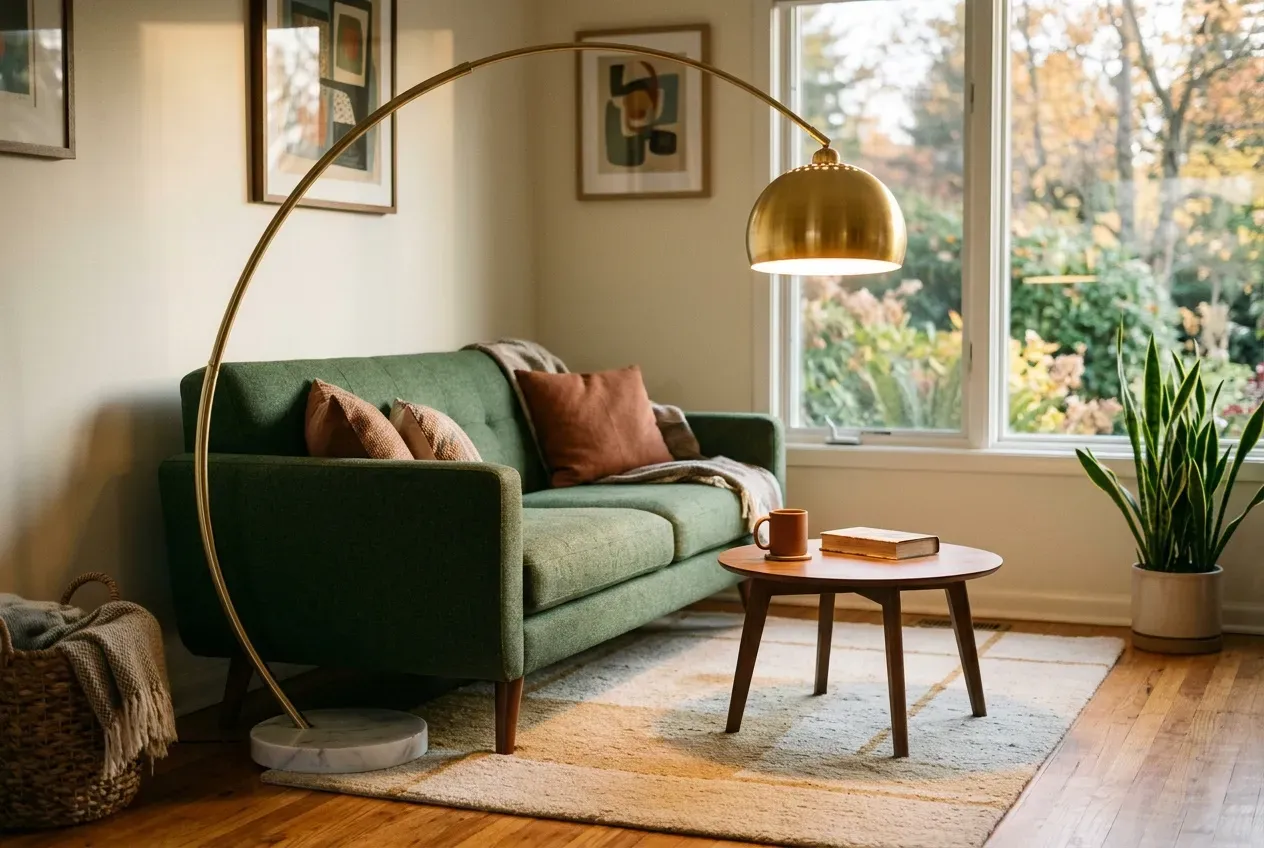
An overhanging arc floor lamp with a marble or spun-metal base and an arched brass arm creates an intimate pool of light over a sofa or reading chair. Tuck the base behind a sofa corner and let the stem curve outward so the shade hovers roughly 55 to 60 inches above the floor. This lights the coffee table clearly without blocking sightlines across the seating area.
Introduce brass and matte black fixtures
Layer in secondary task and ambient lighting:
- Wall sconces: Mount swing-arm brass or matte black sconces beside reading chairs to save surface space on small side tables.
- Table lamps: Choose lamps with ceramic bases, terrazzo columns, or cone-shaped metal shades that cast focused pools of downlight onto wood surfaces.
- Pendants: A multi-arm sputnik fixture or layered white Danish pendant diffuses glare and draws the eye upward to highlight ceiling height.
Warm-white LED bulbs between 2700K and 3000K flatter the amber grain in walnut and the warmth of brass hardware.
Ground the room with low-pile graphic rugs
A living room rug defines the seating perimeter and protects hardwood flooring while introducing subtle geometric patterns underfoot.
Size the rug to anchor all seating legs
Select a rug large enough to extend past the sofa and chairs. All front furniture legs should rest comfortably on the rug, with at least 6 to 8 inches extending beyond the seating edges. This pulls the arrangement together into an inviting zone rather than a scattered set of pieces.
Choose low-pile wool and geometric motifs
Avoid thick shag rugs that trap debris and crush unevenly under chair legs. Flat-weave wool or low-pile tufted rugs hold up better to foot traffic. Simple linear patterns, muted color blocking, or subtle diamond motifs add graphic interest without competing with the wood grain.
Curate art and greenery for a lived-in feel
The final accessories give a mid-century room personal character, separating a real home from a furniture catalog.
Hang large-scale abstract prints in slender frames
Instead of filling walls with small frames, hang one or two sizable abstract prints, color-field canvases, or graphic architectural photographs. Frame them in slender walnut or matte black moldings with generous white mats. Align the center line of the artwork approximately 57 to 60 inches from the floor to meet normal standing eye level.
Add sculptural plants in elevated planters
Greenery softens the clean edges and hard angles of mid-century furniture. Place tall plants such as a fiddle-leaf fig, rubber plant, or snake plant in simple ceramic pots set into raised wooden stands. A trailing pothos on a high bookshelf adds natural contrast against warm wood shelving.
Take a seat on the sofa and review the room from your everyday vantage point. If a tabletop looks cluttered, remove one object. Mid-century design works best with breathing room, allowing the craftsmanship, natural materials, and timeless shapes of each piece to stand out.