The most useful small kitchen ideas start with a clear place to chop and mix. Move utensils off the counter, divide crowded cabinets so you can reach what's inside, and add a mobile work surface only if you have somewhere to park it.
You don't need to use every spare wall or squeeze furniture into every gap. Start where cooking gets awkward: the cutting board balanced beside the toaster, the pan buried under baking sheets, or the cupboard you have to empty to reach the back.
Clear a prep zone with wall storage
Choose the stretch of counter you use for food prep and clear it completely. Put back the appliances you use daily; find cupboard space for occasional ones. Then look at what remains. A utensil crock, spice tray, and drying rack each need a different solution.
Hang everyday utensils on a short rail
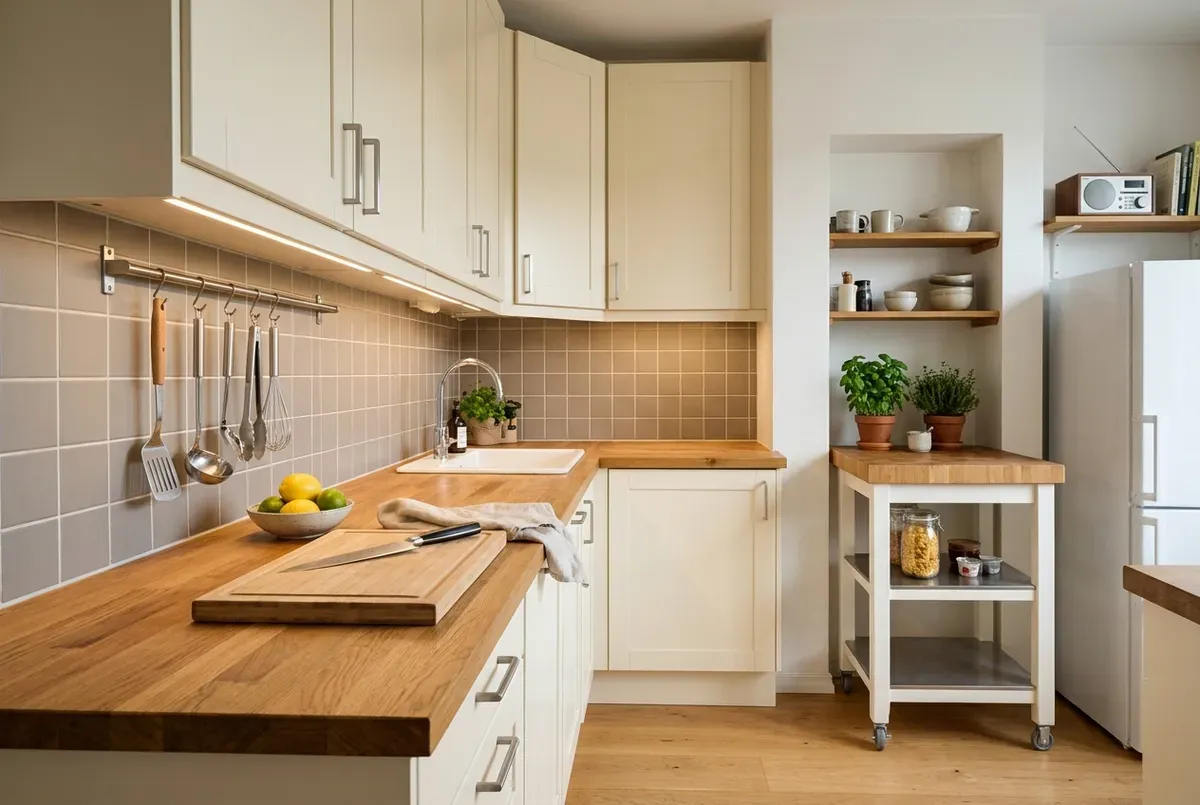
A backsplash rail with hooks can replace a countertop utensil pot. Hang the spatula, tongs, and ladle you reach for most, leaving enough room between them to lift one off without catching its neighbor. Keep the rail beside the prep area rather than directly over the cooktop.
Try the arrangement before committing to a position. Hold the longest utensil against the wall and check that it clears the counter and doesn't interfere with outlets or upper-cabinet doors. A clip-on cup can hold smaller tools, but filling the entire rail with accessories makes the wall crowded again.
For a rental where wall fixings aren't an option, use a drawer divider for those same tools. Clearing the counter matters more than having a particular storage system.
Move drying space over the sink
An over-sink roll-up rack can hold washed dishes while water drains into the basin, then roll away afterward. Choose one that spans your sink securely and leaves the faucet usable. It suits a small daily wash-up better than a large pile of cookware.
If spices are taking over the prep zone, move them to a shallow cabinet shelf or drawer near where you cook. A narrow wall ledge is another option, provided the jars don't project into your working space. Keep open storage selective so the wall remains easy to wipe down.
Add a cart only when it fits your routine
A cart can give you extra storage, a chopping surface, or both. Decide which job you need before choosing its shape. A narrow gap cart is useful for packets and pantry items; it isn't a substitute for a stable prep table.
Choose between a gap cart and a prep cart
For a slim storage cart, measure the whole parking space, including handles, wheels, and anything that projects from the neighboring cabinets. Check that you can pull it all the way out. A gap beside a refrigerator isn't automatically spare storage if it is needed for ventilation or access.
For food prep, look for a cart with a top intended for that use and locking casters. Try the working height, and check that the top stays steady under pressure. Store heavier cookware on a lower shelf rather than loading the top with appliances.
Before bringing either type home:
- Mark its parked footprint on the floor with tape.
- Open nearby drawers, cabinet doors, the oven, and the dishwasher.
- Walk through the kitchen as you would while cooking, including carrying a pan to the sink.
If the cart has to move every time you open a door, choose a smaller one or skip it.
Use a drop leaf for occasional extra surface
A drop-leaf cart works when you need more room for baking or serving but want a shallow unit the rest of the time. Measure it with the leaf raised, including the space you'll stand in. The folded size alone won't tell you whether it works.
Where floor space is already tight, a cutting board designed to fit across your sink can provide a temporary prep surface. You'll lose access to part of the basin while using it, so it works best after washing and draining ingredients.
Make cabinet contents easier to reach
Empty one cabinet at a time and group its contents by use. Measure the interior and the door opening before choosing inserts. Hinges and shelf edges can make the usable space smaller than it first appears.
Divide tall shelves and separate flat cookware
A shelf riser lets mugs or small plates sit above another group without creating one tall stack. Leave enough space to lift items off the lower level. An undershelf basket is better for light, flat items such as napkins or foil boxes; make sure its brackets don't stop the door closing.
Store baking sheets and cutting boards upright in a divider made for that purpose. Each piece should slide out on its own. Keep heavy boards low, where they're easier to lift.
Use door racks and pull-outs selectively
A shallow door rack can hold small packets or lightweight utensils. Test the closed-door clearance with the shelves still loaded: a rack that fits an empty cabinet may collide with plates or pans.
For a deep base cabinet, a pull-out basket brings items at the back within reach. Allow for the runners and frame when measuring. If fitting hardware isn't worthwhile, a handled bin can group baking supplies or food containers so you can pull out the whole category at once.
Brighten the worktop and simplify the finishes
Under-cabinet lighting puts light on the work surface where an overhead fixture may leave shadows. Choose a diffused light bar rather than exposed bright points, and position it so the light reaches the prep area without shining into your eyes.
Warm off-white, cream, or pale gray cabinets can help a compact kitchen feel lighter. Keep the backsplash and counter close in tone if you want fewer strong visual breaks. Sample colors beside the existing finishes in daylight and under your evening lighting before choosing.
You can keep dark lower cabinets or a patterned floor. Clearing the worktop and lighting it well may do more for the room than repainting everything. Start with the storage change that frees your cutting board, then see what still needs attention.